
Topic: Study of the production of charged pions, kaons, and protons in p-Pb collisions at √sNN = 5.02 TeV
In this research project, we have examined the generation of pions, kaons and protons resulting from proton-lead (pPb) collision at √sNN = 5.02 TeV, utilizing experimental data obtained from the ALICE detector at the Large Hadron Collider (LHC).
- The primary motivation behind the study of primary charged particles is to study quark-gluon plasma (QGP) in pPb collisions. Researchers have found the QGP in the lead lead collision where the temperature and densities both are too high, but in the case of pPb collision we have the high temperature not the densities that’s why QGP is not formed. The pPb collisions provide the necessary baseline for ultra-relativistic heavy-ion collisions.
- We used the PYTHIA 8.309 Monte Carlo Event Generator for pPb collisions to achieve our goal. Yield of pions, kaons and protons is produced as a function of pT in pPb collision at √sNN = 5.02TeV in the mid-rapidity range of |y| < 1. The Monte Carlo Event Generator yield is compared with a data obtained from ALICE. The model-generated distribution are displayed alongside the experimental data collected by the ALICE collaboration and sourced from the hepdata database for comparative analysis.
The study primarily focused on
- Produced pion, kaon, and proton yields vs pT in p–Pb collisions at √sNN = 5.02 TeV (|y| < 1).
- The primary motivation to study Quark-Gluon plasma (QGP) in pPb collision
- Provided baseline data for studying QGP formation in Pb–Pb collisions.
- Studied the influence of strange quarks on the strong force.
- Analyzed nuclear medium effects on particle production.
Quark Gluon plasma (QGP):
It is a state of matter where quarks and gluons are freely moving and they are not confined in their radial domains like we have hadronic matter.
QGP has two possible scenarios for the formation:
1) Big Bang
2) Neutrons stars
Problem of QGP
It has very short interval of time the moment it forms and breaks down and condense into hadrons … 10-22sec. We can only observe by producing a little big bang in lab.
Little Big Bang
Scientists have to create a little big bang in the laboratory where we are allowing two nuclei to collide at high energy to reach the condition of QGP, quarks and gluons come from these hadrons and these states are called QGP.
Results and Discussions
Production of pions, kaons and protons in pPb collisions
The Pythia 8.309 distribution for primary charged particles are presented along ALICE data at √sNN = 5.02 TeV with the ALICE at the LHC as a function of pT with a mid-rapidity range of |y| < 1.
- Production of π+,K+ and p
Transverse momentum is produced for (π+, K+) mesons and protons as a function of pT in p-Pb collisions.
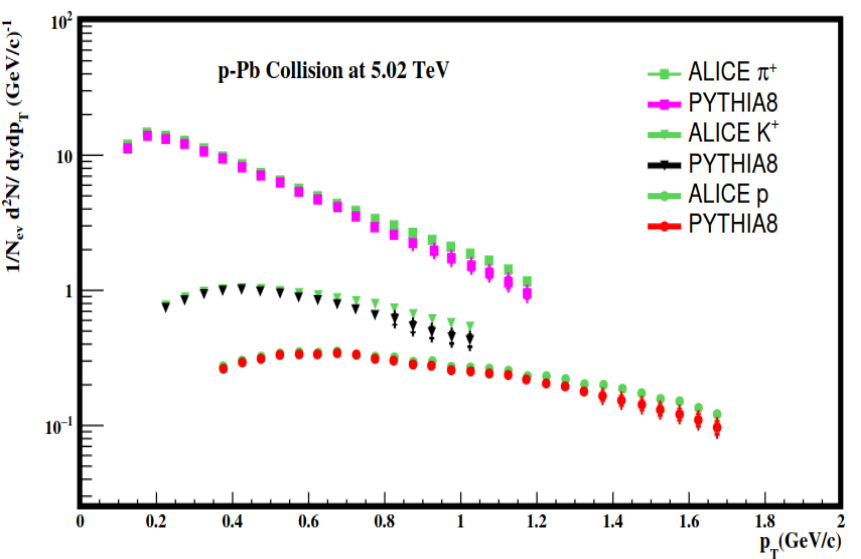
Reason: Pythia8 is plotted along ALICE data distributions. In low pT, model data give us good estimate with ALICE data but deviation in high pT is due to Multiparton interactions (MPI) and due to Perturbative QCD in Pythia model.
- Production of π–, K– and p–
Transverse momentum is produced for (π–, K–) mesons and for antiprotons as a function of pT in p-Pb collisions.
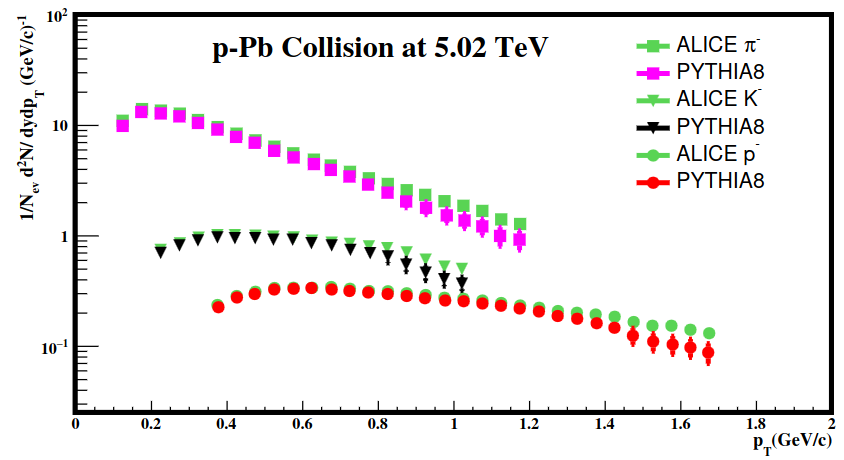
Reason: Pythia8 is plotted along ALICE data distributions. In low pT, model data give us good estimate with ALICE data but deviation in high pT is due to Multiparton interactions (MPI) and due to Perturbative QCD in Pythia model.
- Production of π+, K+ , π++ K+ and proton
Transverse momentum is produced for π+, K+ , π++ K+ and proton in p-Pb collisions at 5.02 TeV and rapidity range is |y|<1.
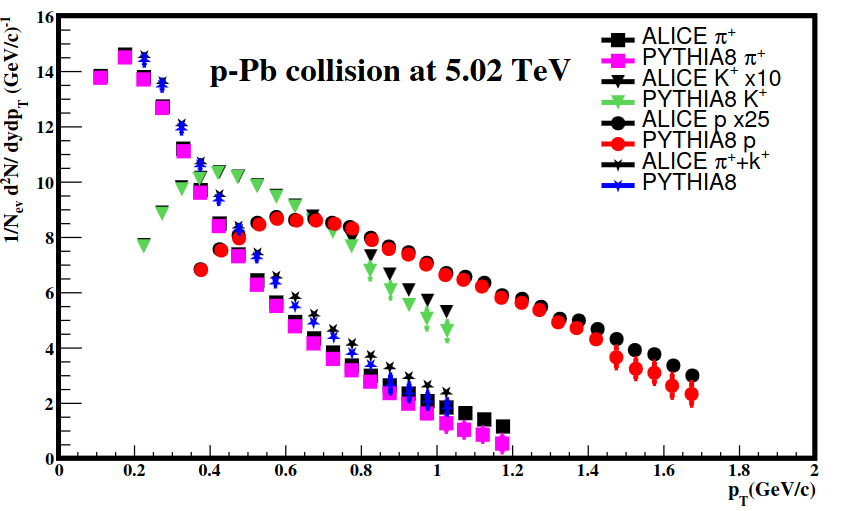
Reason: It seems that model gives us a good estimate with ALICE data, no deviations in low pT but it shows deviation in high pT because of multiparton interactions and perturbative QCD effects in PYTHIA8 model.
- Production of π–, K– , π–+ K– and antiproton
Transverse momentum is produced for π–, K–, π–+K– and antiprotons in p-Pb collisions at 5.02 TeV and rapidity range is |y|<1.
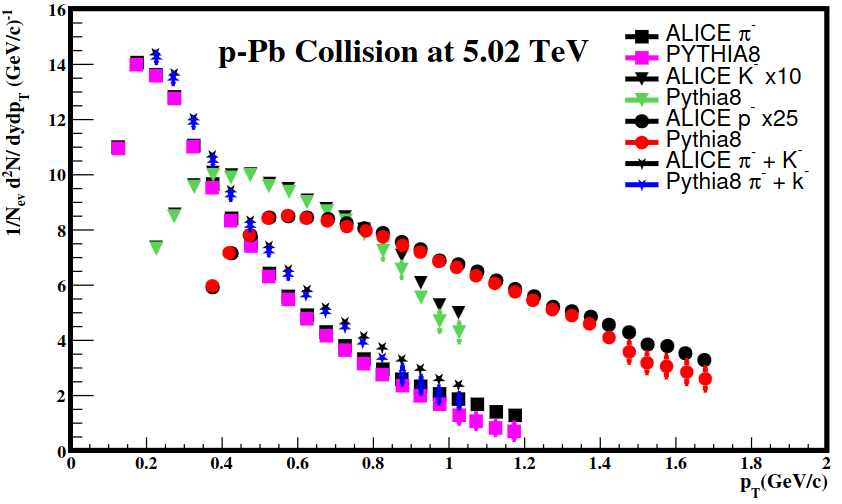
Reason: It seems that model gives us a good estimate with ALICE data, no deviations in low pT but it shows Deviation in high pT Because of multiparton interactions and perturbative QCD effects in PYTHIA8 model.
- Yield ratio
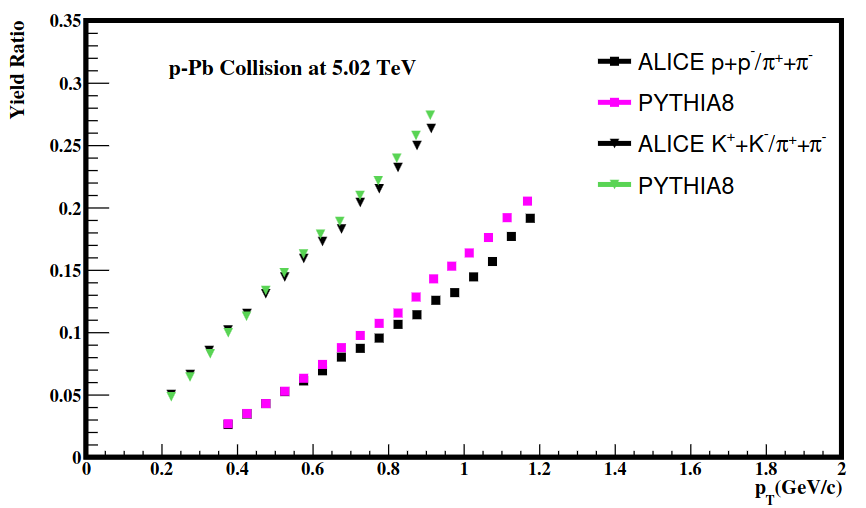
Reason: Pythia 8 distributions are plotted along ALICE data distributions. Model Pythia8 and experimental ALICE Data show that the production of baryon (proton) and kaon increases at high pT values.
- Yield Ratio
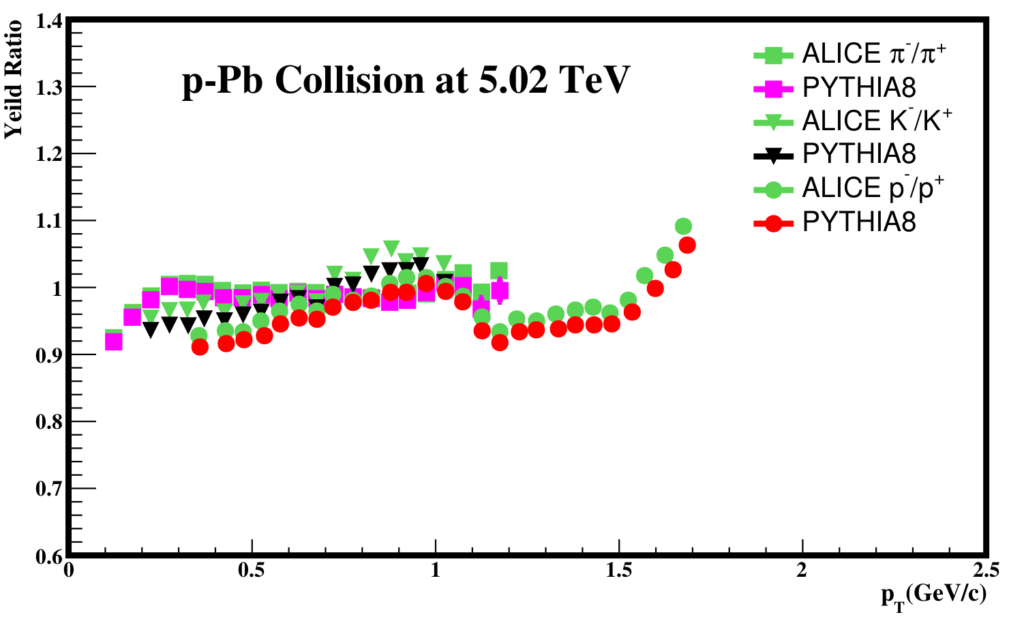
Reason: There is small deviation in high and low pT, as this yield ratio show that production of particle and antiparticle in p-Pb collisions can be roughly balanced at 5.02 TeV. The small deviation in high pT is due to multiparton interactions in Pythia model.
We have used the PYTHIA model to generate the production of π+, π−, K+, K−, P, and P– in pPb collisions. Additionally, we also analyzed the ratio of (p + p¯)/(π++π−) and (K++K−)/(π++π−). Based on the results of our investigation, we can conclude that:
- The PYTHIA prediction underestimates the ALICE data mostly at low pT . At high pT, the PYTHIA yields are higher and overestimate the experimental data.
- Overall, PYTHIA gave a good estimation for π++ π−, K++K−, and p + p– small deviations seen at both low and high pT values.
- The PYTHIA yields for (p + p¯)/(π++ π−) showed good agreement with the experimental data at low pT in the range of 0 < pT < 1 GeV/c, but later it deviated significantly and underestimated the ALICE data at high pT > 1 GeV/c.
- The deviations of the PYTHIA prediction from the ALICE data could be connected to multi-parton interactions at both low and high pT values.