
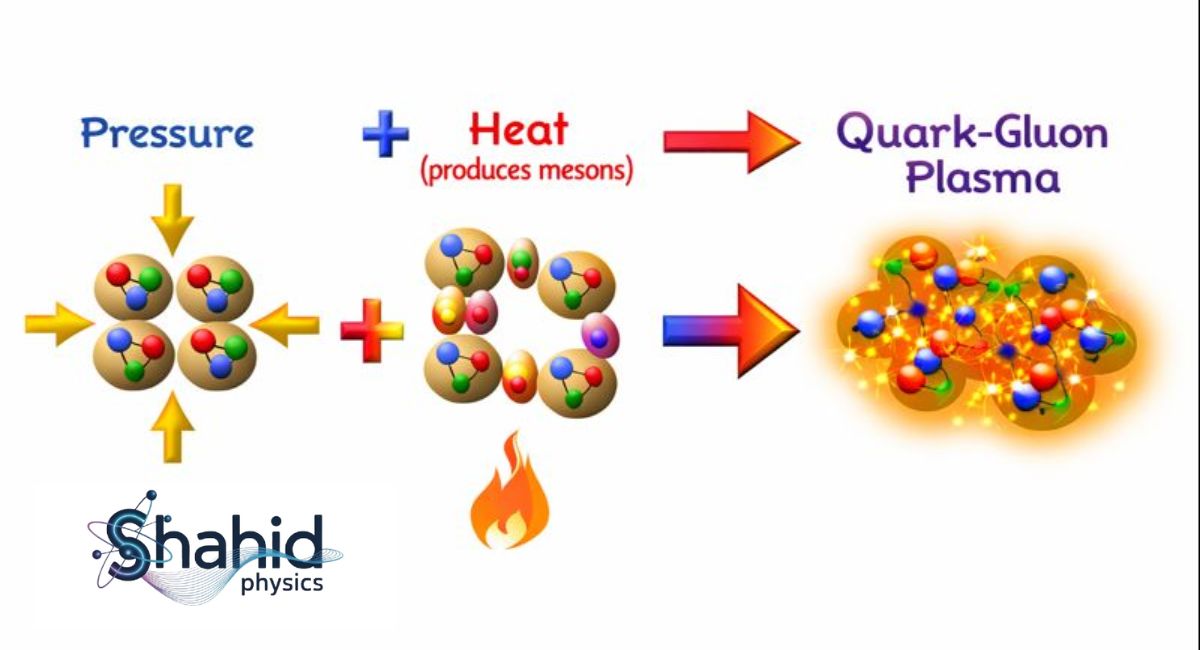
Quark–Gluon Plasma (QGP) is state of matter in which quarks and gluons are not confined inside hadrons (such as protons and neutrons) but move freely in hot dense medium.
The study of QGP allows us to look at universe in its earliest moments less than a microsecond after Big Bang. This reveal the fundamental behavior of matter under extreme conditions. This article explores theory, properties and experimental evidence of QGP which connect high-energy physics experiments with cosmic history. By examining QGP we gain insights the laws governing strongly interacting matter, the origins and evolution of our universe.
Introduction to Quark–Gluon Plasma
Before atoms, matter was in an extraordinary state known as Quark–Gluon Plasma (QGP). This is called “quark soup” this phase allows quarks and gluons to move freely, no longer confined within hadrons. The colour confinement is lifted, and quarks interact through color charge screening under extreme temperatures.
The QGP emerges under extreme conditions predicted by Quantum Chromodynamics via strong interaction. When temperatures exceed the Hagedorn limit matter undergoes a phase transition which demonstrates asymptotic freedom. A property of strong nuclear force (Quantum Chromodynamics) where force between quarks becomes weaker at extremely short distances (high energies), which allows them to act as free particles. The study of QGP enables researchers to uncover the fundamental laws governing the universe’s earliest moments.
Historical Development of Quark–Gluon Plasma Research
The concept of Quark–Gluon Plasma developed during late twentieth century. The physicists Léon Van Hove introduced it as groundbreaking idea and E. V. Shuryak later formally named it. The theoretical studies provided the theoretical foundation before experimental efforts, and many initially questioned whether this phase could ever be observed under laboratory conditions.
These doubts gradually decreased with results from CERN and thereafter at Brookhaven National Laboratory. The early indications appeared at Super Proton Synchrotron (SPS) while more definitive evidence emerged from Relativistic Heavy Ion Collider (RHIC) and Large Hadron Collider (LHC). Each facility enhanced the precision of measurements and each finding strengthened the scientific acceptance of QGP.
Why Study Quark–Gluon Plasma?
The early universe provides critical insights into origin of matter. During quark–gluon plasma phase of early universe, matter existed in form of hot deconfined plasma. The study of this phase allows researchers to reconstruct conditions present at birth of the universe, while modern laboratories recreate these extreme environments on extremely short timescales.
In addition to cosmological significance QGP research addresses fundamental questions in particle physics. Investigations of quark confinement advance theoretical understanding and explain protons and other hadrons emerge as universe cool. Each experiment resolves long standing questions while simultaneously revealing new challenges.
Relation Between Quark–Gluon Plasma and Ordinary Plasma
Ordinary plasma, such as that found in neon lights and stars allows electric charges to move freely. In contrast, Quark–Gluon Plasma (QGP) liberates color charges leading to fundamentally different behavior. Unlike electric forces, strong color forces govern interactions between quarks and gluons resulting in dynamics unique to this extreme state of matter.
The table below highlights the contrast.
| Property | Ordinary Plasma | Quark–Gluon Plasma |
| Charge type | Electric | Color |
| Screening | Coulomb | Non-abelian |
| Particle freedom | Electrons | Quarks and gluons |
| Stability | Common | Extremely brief |
Both exhibit fluid-like properties; however only QGP exposes the strong force in its unconfined form.
Theoretical Foundations of Quark–Gluon Plasma
The study of QGP requires advanced computational and theoretical tools. Lattice gauge theory maps space onto discrete lattice which allows computers to solve otherwise intractable equations and reliably predict phase transitions and thermodynamic properties.
Additional insights arise from string theory concepts particularly the AdS/CFT correspondence, which establishes connection between gravitational systems and quantum fields. The fluid/gravity correspondence further elucidates liquid-like behavior of QGP. Together these frameworks provide a comprehensive theoretical understanding of its unique properties.
Conditions Required for Quark–Gluon Plasma Formation
QGP forms only under extreme conditions. Temperatures must reach approximately 150–160 MeV, corresponding to trillions of Kelvin. The energy densities rise above 1–5 GeV/fm³, far exceeding ordinary matter.
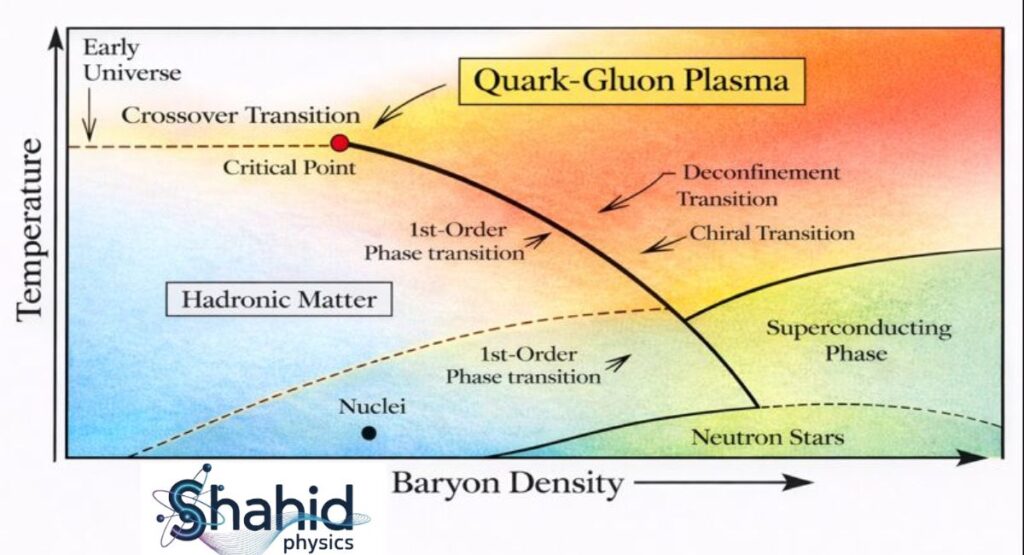
Such states do not occur naturally in present universe, appear only during high-energy heavy-ion collisions. The QGP exists for less than fraction of a second, making precision timing critical for observation.
Production of Quark–Gluon Plasma in High-Energy Collisions
Physicists collide heavy nuclei at ultra-relativistic speeds generating extreme compression of matter. These heavy-ion collisions produce a hot, dense core referred to as fireball.
During fireball’s expansion quarks and gluons move freely, followed by rapid cooling. Then hadronization occurs, reconstructing ordinary matter. The traces of QGP are contained within the resulting particle debris, requiring careful analysis for detection.
Experimental Facilities Studying Quark–Gluon Plasma
Several major facilities lead research on QGP. Brookhaven National Laboratory operates the Relativistic Heavy Ion Collider (RHIC) in New York. Physicists perform precision gold–gold collisions there. These experiments probe extreme states of matter.
In Europe CERN host Large Hadron Collider (LHC). It conducts lead–lead collisions at extremely high energies. Detectors as ALICE, CMS and ATLAS collect extensive data. Each focuses on specific observables. These experiments allow scientists to detect the subtle signals of QGP. They provide insight into its unique properties.
Diagnostic Tools for Detecting Quark–Gluon Plasma
QGP cannot be observed directly, scientists deduce its presence through various signals. Jet quenching demonstrates energy loss in the medium. Elliptic flow reveals pressure gradients. Together, these phenomena indicate collective flow behavior.
Additional evidence comes from rare particles. Strangeness production increases sharply. The observed patterns align with theoretical predictions. Over time, experimental results accumulate consistently strengthening the evidence for QGP.
Thermodynamic Properties of Quark–Gluon Plasma
Thermodynamics describes the behavior of QGP. The equation of state relates pressure to energy density. At high temperatures results follow Stefan–Boltzmann law.
Simulations confirm a smooth crossover behavior, no sharp transition occurs. This insight has reshaped expectations regarding the QGP phase change.
Collective Flow and Hydrodynamic Behavior
QGP exhibits remarkable collective flow. Experiments revealed it behaves as a perfect liquid. Its resistance to flow remains extremely low, making it a near-zero viscosity fluid.
This flow influences particle emission angles. Measurements are consistent with hydrodynamic models. In this case, theory and experimental data show strong agreement.
Jet Quenching and Energy Loss Mechanisms
High-energy particles produce collimated jets. When these jets traverse the QGP medium, they experience significant energy loss. This phenomenon is known as jet quenching. Its magnitude depends strongly on the density of the medium.
Measured energy-loss rates provide insight into the internal structure of QGP. The observations support the Bjorken model of longitudinal expansion. These findings remain consistent across different experimental facilities.
Electromagnetic Probes: Photons and Dileptons
Certain probes escape the medium with minimal interaction. Thermal photons are emitted at early stages of the collision. Dilepton production reflects the initial temperature of the system. These electromagnetic probes are largely insensitive to the strong interaction.
Additional evidence comes from J/ψ suppression. Heavy quark–antiquark bound states dissolve in the plasma. Their reduced yield provides a clear signal of deconfinement.
Quark–Gluon Plasma in the Early Universe and Neutron Stars
This topic connects cosmology and nuclear physics. Shortly after the Big Bang, the Universe existed in a quark–gluon plasma phase. As the Universe expanded and cooled quarks and gluons combined to form hadrons.
The atrophysical studies add further interest. Some theoretical models predict the presence of QGP in the cores of neutron stars. Others propose that a glasma state may precede plasma formation. The nature and onset of deconfinement remain active areas of research.
Future Directions in Quark–Gluon Plasma Research
Research on QGP continues to advance. New detectors improve experimental precision. Enhanced simulations refine theoretical models. Each development deepens understanding of Quark–Gluon Plasma: Theory, Properties, and Experimental Evidence.
The field remains driven by fundamental curiosity. Ongoing research advances our knowledge of early Universe.