

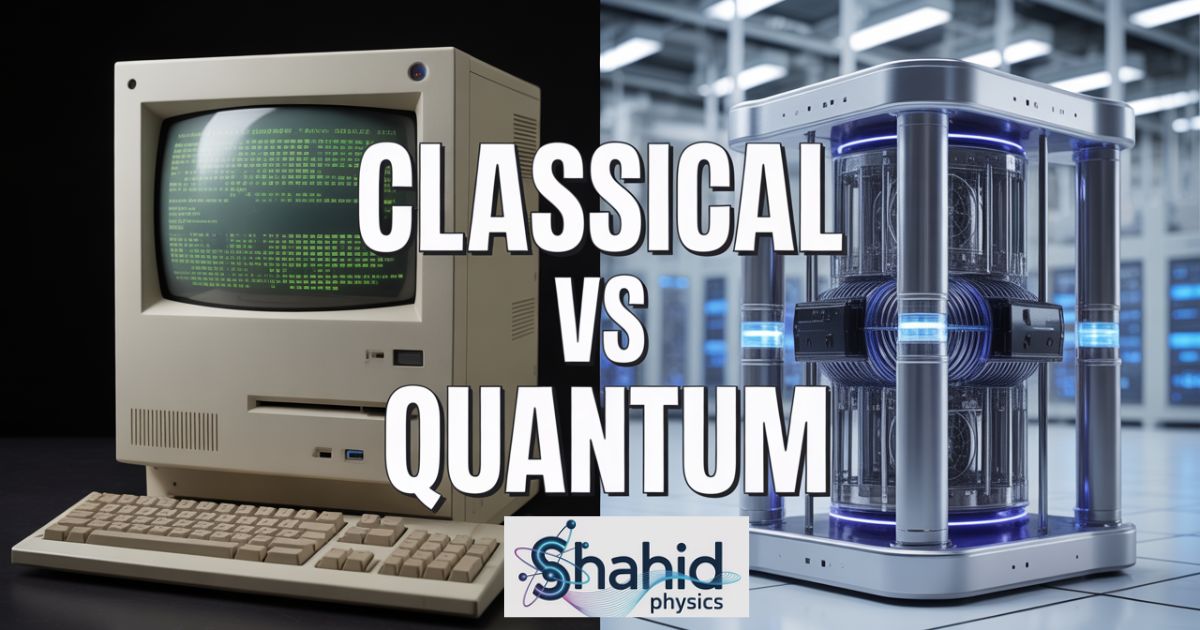
Quantum computing redefines modern technology approaches to solve complex problem. When we compare this with classical computers this emerging field relies on quantum physics to process information. This used qubits instead of bits, quantum computing technology can explore multiple solutions at the same time, offering an exponential speedup for certain tasks. This capability makes it especially valuable for advanced research, cryptography and scientific discovery.
Classical computers continue to play their essential role in everyday tasks and routine work. However quantum machines enable new possibilities that were previously impossible. As research, investment, and technological development continue to grow, understanding of quantum computing is becoming important for global technological progress.
What Is Classical Computing?
Classical computing systems process information using bits. Bit has only one state at a time either 0 or 1. This simple rule makes classical computers stable and predictable. The engineers depends on deterministic computing where the same input always leads to the same output.
Because of this reliability classical computers dominate daily life. Email, video calls, banking systems and online shopping all depend on them. These machines operate efficiently at room temperature and scale easily. This practicality explains why classical computing remains essential.
What Is Quantum Computing?
Quantum computing takes a very different path. Instead of bits it used qubits. These machines follow quantum mechanics principles which describe behaviour of particles at extremely small scales. This allows quantum systems to solve problems that classical computers cannot handle efficiently.
The quantum computing technology is focused on particular problem rather than everyday computing. Governments and technology companies in the United States invest heavily because quantum systems promise breakthroughs in science, security and industry. Although quantum computing is still developing its future potential is significant.
What are qubits and how they work?
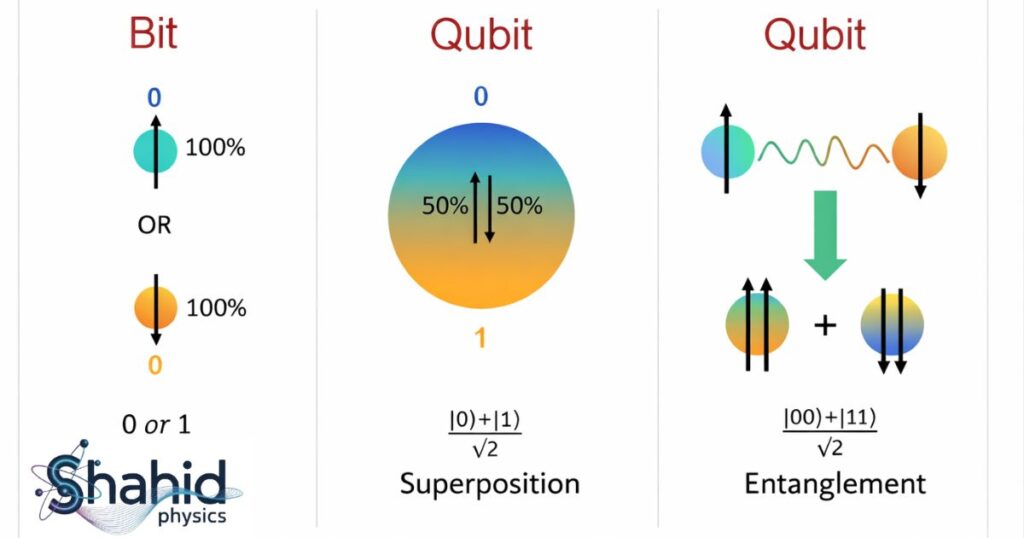
The debate over qubits vs bits defines the difference between quantum and classical computing. A bit holds one value at a time. A qubit can exist in multiple states simultaneously through superposition and entanglement. This ability allows quantum systems to explore many solutions at once.
When qubits interact, quantum interference helps amplify correct outcomes. Once measured, quantum states collapse into a single result. This process enables probabilistic computing, where accuracy improves by running calculations multiple times rather than relying on one outcome.
Quantum Computing vs Classical Computing: main Differences
The key difference how information is processed. Classical computers process data step by step, following one clear path at a time. Quantum computers explore many paths simultaneously. This leads to a dramatic computing power comparison between the two systems.
Classical machines rely on certainty. Quantum systems accept uncertainty and probability. Classical computing excels at reliability. Quantum computing offers exponential speedup in solving complex computational problems. This contrast explains why both technologies are valuable.
How Quantum Computers are different from classical computers
Quantum computers operate under extreme conditions. Qubits are fragile and easily disrupted by heat or noise. This disruption is known as quantum error and decoherence. To prevent it, systems run at near absolute zero temperature using advanced dilution refrigerators.
In contrast classical computers function in normal environments. This difference highlights major quantum computing challenges including high costs, complex infrastructure and limited scalability.
Key principles of Quantum Computing
Quantum systems rely on rules that feel counterintuitive. Superposition and entanglement allow qubits to share information instant. Reversible quantum operations ensure information is never lost during computation.
These principles enable quantum parallelism, where many calculations occur at the same time. Unlike classical logic gates, quantum gates preserve information. This property unlocks performance that classical systems cannot achieve.
10 Major Differences Between Quantum and Classical Computing
The differences arise in physics, design and outcomes. Classical machines use deterministic computing while quantum machines deliver probabilistic results. Classical systems scale linearly while quantum systems scale exponentially with qubits.
| Aspect | Classical Computing | Quantum Computing |
| Data unit | Bit | Qubit |
| Logic | Deterministic | Probabilistic |
| Scaling | Linear | Exponential |
| Physics | Classical | Quantum |
| Speed | Incremental | Exponential |
| Temperature | Room temperature | Cryogenic |
| Error handling | Simple | Complex |
| Best use | General tasks | Complex simulations |
| Security impact | Stable | Disruptive |
| Maturity | Fully developed | Experimental |
Advantages of Quantum Computing over Classical Computing
The most important quantum computing advantages come from speed and scale. Quantum machines can search massive solution spaces instantly. This power is crucial for complex optimization problems that overwhelm classical systems.
Quantum computers also excel at simulations. They naturally model physical systems, making them ideal for research that once required decades of computation.
Advantages of Classical Computing
Despite quantum progress, classical computers remain dominant. They are affordable, reliable and widely accessible. Software ecosystems are trusted and most tasks simply do not require quantum power.
Classical systems also avoid the limitations of quantum computing. They do not need cryogenic cooling. They do not suffer from fragile states. All this makes ideal for everyday use.
Limitations and Challenges of Quantum Computing
Quantum computing faces serious obstacles. Qubits lose information quickly. Error correction requires many physical qubits for a single logical qubit. These quantum computing challenges slow large-scale adoption.
Costs remain high. Specialized hardware, cooling systems, and skilled teams limit accessibility. These factors explain why quantum computers are still rare outside research labs.
Real World Applications of Quantum Computing
Current quantum computing applications focus on high impact fields. Molecular simulations help scientists design new drugs and materials. Large-scale simulations improve climate and energy research.
Industries also use quantum systems for supply chain optimization and finance. High-dimensional data processing allows faster pattern detection than classical tools.
How fast Quantum Computing Compared to Classical Computing?
The quantum computing speed comparison depends on the problem. For number factorization, Shor’s algorithm outperforms classical methods dramatically. Google demonstrated quantum supremacy by solving a task classical supercomputers could not finish in a reasonable time.
However quantum speed does not apply to everyday tasks. Browsing the web or editing documents remains faster on classical machines. Quantum advantage appears only in specialized domains.
Quantum Computing and Cybersecurity Threats
One of the most serious concerns is encryption. RSA encryption protects financial systems, government data and personal information. Quantum computers can break it, creating a serious quantum threat to cryptography.
To counter this risk researchers develop quantum key distribution (QKD). QKD improves cryptographic security by detecting interception instant. The Governments and industries are already preparing for this shift.
Quantum Computing Future
The future depends on hybrid systems. Classical and quantum machines will work together. Quantum processors will solve complex cores. Classical computers will handle control and usability.
Researchers expect growth in quantum machine learning, quantum neural networks, and quantum support vector machines. Algorithms like Quantum Approximate Optimization Algorithm will transform decision making. Progress is gradual but the impact will be historic.
“Quantum computing will not replace classical computing. It will redefine what is computationally possible.”
— IBM Quantum Research
Quantum computing vs classical computing is not a rivalry. It is a partnership. One powers the present. The other opens the future.